Elite personalized training

Athletic success requires the right things, in the right place, at the right time.

In The Core Elite is semi-private sports performance training in Boulder for athletes from eight years old up. One coach per one to four athletes. One or two sessions a week, every one of them tailored to the individual athlete.

We’ve been doing this here for twenty-plus years, with over a thousand athletes across more than thirty sports.

Already in the program? Book your sessions on Booksy.

Is this right for your athlete?

From eight years old up, with no upper end. The same program runs for youth athletes just starting out, middle-school and high-school athletes, college athletes, and adults who still compete.

Athletes are not grouped by age. Programming runs in levels set by training ability: how long an athlete has actually trained, and how well they control their own body. From there it is tailored to the individual.

An eleven-year-old with two years behind her and a fifteen-year-old who has never lifted are not at the same starting point, and treating them as though they were is how young athletes get hurt.

How you start

1. Fill out the Train With Us form. A few minutes. It tells us the athlete’s sport, age, season, and history.

2. Aaron calls you. Aaron Vogel founded In The Core and heads performance here. He’ll talk through where the athlete is, what their season looks like, and whether what we do is the right fit, including when it isn’t.

3. First session. Come a few minutes early so we can meet the athlete properly. Parents are welcome to wait in the lobby.

Sessions run Monday to Thursday, 2:30 p.m. to 8:00 p.m., and Friday, 2:30 p.m. to 6:30 p.m..

The inside-out approach

Most training starts on the outside, with a muscle group. We start where movement starts, with the decision.

Every athletic action runs the same chain. The athlete reads the situation and chooses. The brain sends the signal down the spinal cord, where it meets everything the body is feeling right then. Motor units fire. How many fire, and how fast, decides everything after it: force, the way tendons store and return that force, and the movement itself.

What the athlete asks of that firing decides the adaptation. Maximal intent at high speed trains speed and power. High force demands train strength. Repeated efforts with little recovery train endurance.

It runs both ways. Every attempt feeds back up the chain and adjusts the next one. That is what learning a movement is.

Decision-making, reaction, and technique all degrade as fatigue builds, so the session trains them first and leaves conditioning for last. The order is the method.

That whole sequence, decision through to performance, is what we mean by Total Athleticism.

How we know it’s working

Three to four times a year, every athlete goes through a performance testing battery: strength, speed, power, aerobic fitness, anaerobic fitness, and other measures.

It shows the athlete and their family what has actually changed, in numbers rather than impressions. And it tells us whether the programming is working, because a coach’s confidence that a plan is good is not the same as evidence that it is.

The In The Core methodAn athletic action runs from the athlete’s psychological and task state through sensing and selecting, preparing and predicting, descending neural control, spinal integration, and motor-unit output, then muscle force, muscle-tendon mechanics, and movement and technique, expressed as strength, power, speed, and endurance. Sensory feedback returns to sensing and to spinal integration, fatigue and physiological feedback returns to sensing and to descending neural control, and energy and physiological support sustains the muscle stages.Psychological & Task Stategoal · motivation · attention · readinessSense & Selectperception · action choicePrepare & Predictplanning · feedforward controlDescending Neural Controlbrain + brainstem signalsSpinal Integrationdescending · sensory inputMotor-Unit Outputrecruitment + discharge rateMuscle Forcecalcium release · contraction · forceMuscle-Tendon Mechanicsarchitecture · tendon · elastic behaviorMovement & Techniquecoordination · timing · force applicationmodulatesselects & informspreparesdrives & modulatesshapesgeneratesgeneratestransmits force toexpresses asTASK-SPECIFIC PERFORMANCEStrengthmax forcePowerforce × velocitySpeedrapid movementEndurancesustained outputsensory feedbackfatigue / physiological feedbackEnergy and physiological support sustains the muscle stages:ATP supply, oxygen delivery, thermoregulation.
The In The Core methodAn athletic action runs from the athlete’s psychological and task state through sensing and selecting, preparing and predicting, descending neural control, spinal integration, and motor-unit output, then muscle force, muscle-tendon mechanics, and movement and technique, expressed as strength, power, speed, and endurance. Sensory feedback returns to sensing and to spinal integration, fatigue and physiological feedback returns to sensing and to descending neural control, and energy and physiological support sustains the muscle stages.Psychological & Task Stategoal · motivation · attention · readinessSense & Selectperception · action choicePrepare & Predictplanning · feedforward controlDescending Neural Controlbrain + brainstem signalsSpinal Integrationdescending · sensory inputMotor-Unit Outputrecruitment + discharge rateMuscle Forcecalcium release · contraction · forceMuscle-Tendon Mechanicsarchitecture · tendon · elastic behaviorMovement & Techniquecoordination · timing · force applicationmodulatesselects & informspreparesdrives & modulatesshapesgeneratesgeneratestransmits force toexpresses asTASK-SPECIFIC PERFORMANCEStrengthmax forcePowerforce × velocitySpeedrapid movementEndurancesustained outputSensory and fatigue feedback loop backto the earlier stages.Energy support sustains the muscle stages:ATP, oxygen delivery, thermoregulation.
What a session looks like

Ninety minutes, in four blocks

1

Readiness

Reaction time, decision-making, ambidexterity, and balance work, then activation for the joints and muscles about to do the work. The block most gyms skip, and the one that sets the tone for everything after it.

2

Response

Running mechanics, quickness, change of direction, agility, power, precision. Pushing the edge to optimize where decisions become actions, both generally and sport-specifically.

3

Performance

Speed, strength, and power. Form first, then balanced development, then intensity raised deliberately. Always finishing in situations that look like their sport, so the capacity shows up in their sport.

4

Finisher

A finisher, a burnout, or extra active recovery. Chosen for what the athlete needs that day and what is already in their week.

Every session is different. None of them are improvised.

Sessions run inside a gym-wide long-term athlete development plan. That plan is our periodization, a flexible annual scaffolding rather than a fixed program. Every session is tailored inside it three ways: to the individual athlete’s needs, to the demands of their sport, and to where they are in their sport’s season.

A goalkeeper and a distance runner train the same week, off the same outline. Different variations, for different reasons, at the same point in the same plan.

Before you call

Age, safety, and cost

What does it cost?

We don’t publish a price, and it is worth saying why. Sessions are semi-private and individually programmed, so the number depends on how often an athlete trains and the length of the block. We give you a firm figure on the call, with no obligation. If price is an issue, we are always willing to work with you to find a solution.

At what age should a child start strength training?

We take athletes from eight. That surprises people, usually because “strength training” brings a loaded barbell to mind. At eight it means learning to land, decelerate, change direction, and hold position under control. Loaded work is a later chapter, and it arrives when an athlete’s level says so, not when their birthday does.

Is it safe for a growing athlete?

Yes, when the program respects development instead of treating a fourteen-year-old as a small adult. That is what the long-term development plan exists to do, and it is why every session opens with readiness and activation rather than load.

How often would my athlete train?

One or two sessions a week alongside their sport.

My athlete is in season. Is that a bad time to start?

No. In-season work looks different, with the performance block shifting to maintain rather than build. In season is also when it matters most, because game and practice load is at its highest and the qualities that hold up under it, strength, tissue tolerance, and control when decelerating and changing direction, fade first once training stops. Those are the same qualities that keep an athlete on the field. Stopping in season is how athletes arrive at the next season further back than they finished the last one.

What if they play more than one sport?

Good. Multi-sport athletes are generally the ones we worry about least. We program around the calendar they actually have.

Questions? We would love to answer them

Tell us about your athlete and Aaron will be in touch within the week. He calls rather than emails, because the first useful step is a real conversation: the sport, the season, and what you’re hoping training does for them.

Working to a tighter deadline, like a season starting or a tryout coming up? Say so in the form and we’ll move you up.

Here at ITC, we educate athletes on the importance of different lifestyle choices on recovery and performance. This pyramid of recovery concepts provides an overview for how we teach athletes about recovery and how significantly it can affect their performance.
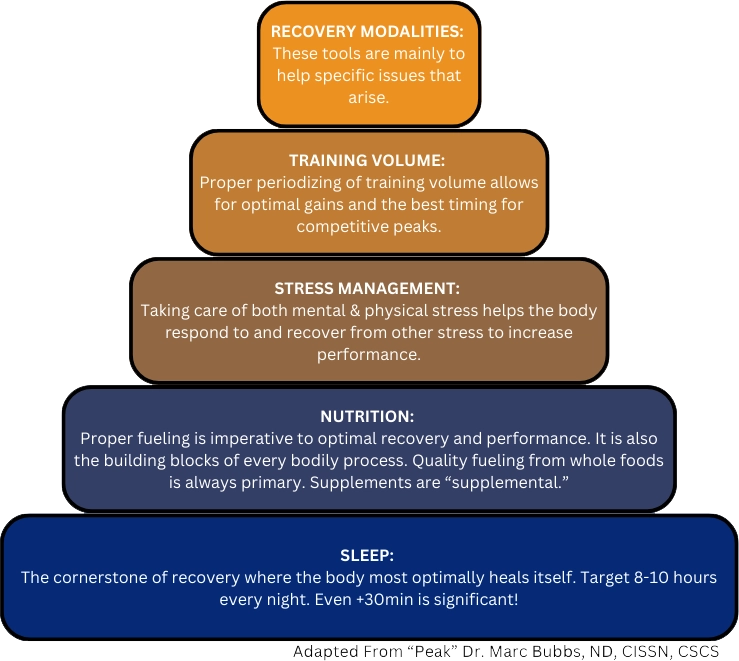
Recovery pyramid with sleep as the base, then nutrition, stress management and training volume, and recovery modalities at the top — the tools nearest the base matter most.

Geno's Story

My son Dante has been training at In The Core since 2019 and my daughter Ava has been training there since 2023.  They are both year-round athletes that put a lot of stress demand on their bodies through their respective sports and consequently they put stress on their minds through school, sports, social life, etc.  With that said, when we found ITC we were drawn to not only the physical athletic training but also the mind/brain work and encompassing everything all into one.  Simply put, training the full body not only for competition but also the life of a teenage student-athlete and the preparation into adulthood.  There are many options in the market if you’re looking to just get bigger, faster, stronger but if you are like us, and you were looking for more than that, ITC is the place to come.
 
The coaching and training aspect of ITC is impeccable.  The details and focus of every session will ensure your athlete has an incredible workout that is tailored to them individually every time they visit.  The brain work and the messages they learn through the training has my kids walk out of ITC sessions a completely different person.  They are more upbeat, energetic, and motivated even though they just performed an intense work out for 45-90 minutes.
 
As a former athlete, it is very evident to see the physical results in their training.  As a parent, I see my children’s growth in their mindset and maturity.  I see them thinking about their futures in ways they never did before, I see their motivation in helping and be a part of the solution, and I see them wanting to serve something higher than themselves.  For me and my family, this means being a complete athlete which is what they receive from the team at ITC.
 
ITC has been a huge blessing for our whole family.  The lifelong friendships and relationships that we have developed and the tools that our children have received are priceless.  We are forever grateful and forever ITC!